
arch. alberto sanquilico
Via A.Casagrande, 1 - 15011 ACQUI TERME (AL) - Mob.+39 338 99.21.731 - sanquilico@gmail.com

RENOVATION
For a New Way of Living in Italy
Designing a home is not about applying standard solutions, but about listening, interpreting, and transforming needs, habits, and visions into authentic spaces.


As an architect, I see myself first and foremost as a tailor: every project begins with a careful dialogue with the client and takes shape like a bespoke garment, precisely crafted around those who will live in it every day.

Nothing is off the shelf, nothing is accidental.
Proportions, materials, light, and details are selected and calibrated with the same artisanal care as a handmade piece.
Each home thus becomes a unique project, capable of reflecting the personality of its inhabitants, enhancing their lifestyle, and standing the test of time—both functionally and aesthetically.

This is my work: transforming real needs into architecture, tailoring spaces that are not only beautiful, but truly yours.

ARCHITECTURE IS MEMORY
As an architect,
I can help you recognize the home
that truly aligns with your needs,
your habits, and the way you want to live in Italy.
From the first evaluation to its transformation into a tailored living space,
I can help you find the right place to build your life—one
that aligns with your lifestyle, expectations, and long-term vision.
(John Ruskin)
LIFE BY THE POOL


In Italy, summer turns the swimming pool into much more than an architectural feature—it becomes a place for gathering, connection, and shared experiences.
Life naturally unfolds around the pool: informal lunches that stretch into sunset, spontaneous conversations, and relaxed moments shared with family and friends. It is a space where time slows down and conviviality takes shape effortlessly, fully reflecting the Italian way of living.
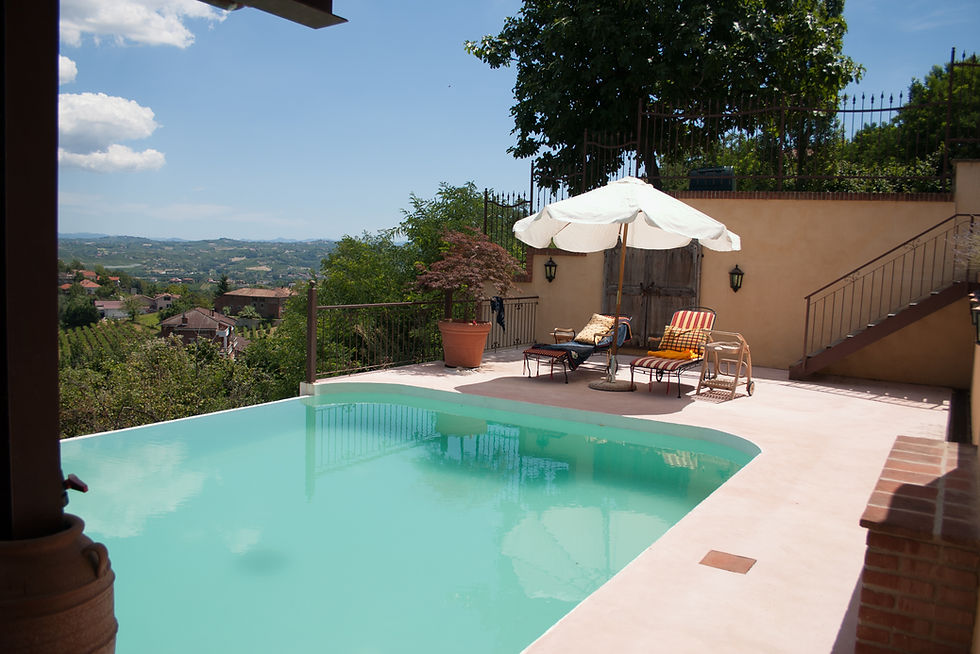

The pool is not just about leisure, but about quality of life. It encourages social interaction, invites people to enjoy outdoor living, and creates authentic moments of togetherness, strengthening the bond between the home and its surrounding landscape. During the summer months, it becomes the vibrant heart of the home—balancing wellbeing, pleasure, and simplicity.
Living with a pool in Italy means embracing a lifestyle defined by warmth, light, relationships, and comfort, where everyday moments find their ideal setting.

TIMELESS VIEW
The panorama of the Piedmont hills is one of the defining elements that makes the farmhouses of this region truly beautiful and distinctive.
The gentle lines of the landscape, the ordered rows of vineyards, and the cultivated fields become an integral part of the architecture, naturally interacting with rural volumes and open spaces.
These farmhouses sit within the territory with balance and restraint, enhanced by wide, ever-changing views that accompany everyday life. It is this authentic relationship between architecture and landscape that gives Piedmont farmhouses a timeless character, defined by harmony, beauty, and a high quality of living.


THE PORTICO
In the context of Italian rural architecture, the portico plays a fundamental role in fully enjoying the summer season.
It provides shade during the hottest hours, encourages natural ventilation, and creates a seamless connection between indoor and outdoor spaces, making the home more comfortable and livable.
The portico thus becomes a true living area: a shaded space for outdoor dining, social moments, and relaxation, where the rhythm of daily life adapts to the climate and the surrounding landscape. In summer, it is where rural architecture best expresses its purpose, combining comfort, tradition, and quality of living.

The portico, enhanced by an outdoor summer kitchen, becomes a central space for outdoor living, ideal not only for everyday use but also for hosting friends and social gatherings. It is a place designed for sharing—cooking, dining, and extending summer evenings in a relaxed and natural way.
Thanks to its covered structure, the portico provides a highly functional space even when it rains, allowing outdoor living to be enjoyed throughout the summer, regardless of the weather. It becomes a true extension of the home: a protected, versatile, and welcoming area that offers comfort, sociability, and a high quality of living outdoors.
THE KITCHEN

Designing a kitchen within a rustic setting means finding the right balance between character, functionality, and simplicity. It is precisely in these contexts that a well-designed kitchen reveals its true value: clear layouts, fluid circulation, and practical solutions make the space highly usable and easy to live in on a daily basis.
Often, a minimal style proves to be the most effective choice. Clean lines, carefully selected materials, and a restrained use of elements allow the kitchen to engage in a dialogue with the rustic surroundings without overpowering them, instead enhancing their authenticity.
The result is a kitchen that is discreet yet powerful, combining efficiency, comfort, and identity, and becoming a functional, welcoming space that is perfectly integrated into the existing architecture.


The Heart
of
Italian Living
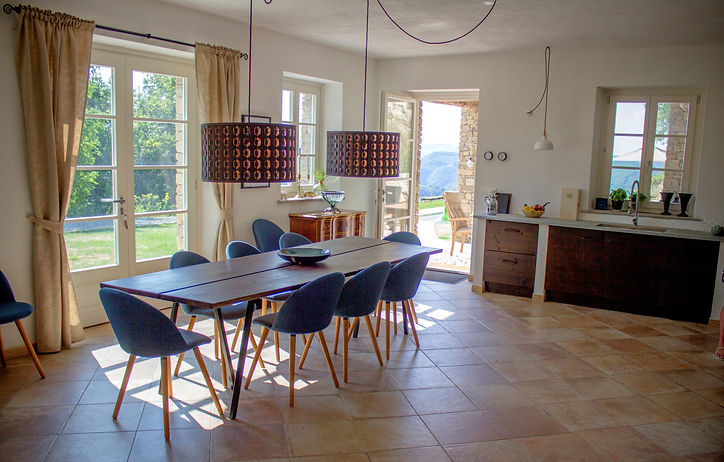
The Italian kitchen has always been one of the most lived-in spaces of the home, a central place dedicated to conviviality, gathering, and sharing. It is not simply where food is prepared, but where people come together, talk, cook side by side, and spend meaningful time.
_edited.jpg)
It is here that friends are welcomed in an informal way, families gather every day, and everyday moments turn into opportunities for connection. The kitchen thus becomes the true heart of the home, a space for slowing down, being together, and strengthening relationships—fully expressing the convivial spirit of the Italian way of living.


ROOMS FOR REST
AND INTIMACY
In the sleeping area, comfort and the use of warm tones play a fundamental role in defining the quality of living. Bedrooms are spaces dedicated to rest and recovery, where every element should contribute to creating a calm and protected atmosphere.
Warm, enveloping colors, natural materials, soft fabrics, and carefully designed lighting enhance wellbeing and help disconnect from the rhythm of the day. Comfort is not only an aesthetic matter, but also relates to how space is perceived—silence, temperature control, and a sense of intimacy.

Comfort
as a Design Principle
A well-designed bedroom thus becomes a place of balance and tranquility, capable of offering deep rest and a higher quality of life, fully enhancing the role of the sleeping area within the home.

MATERIALS MATTER

In a renovation project, the recovery and reuse of the building’s original materials play a central role, both from a cultural perspective and in terms of architectural quality. Reusing existing elements—such as masonry, stone, bricks, timber beams, or historic finishes—means preserving the memory of the building and maintaining an authentic connection with its history and identity. Original materials are an integral part of the architectural language and contribute in an irreplaceable way to the character of the spaces.
Alongside this approach, the use of locally sourced materials represents a design choice of significant value. Local materials ensure coherence with the surrounding landscape and construction traditions, promote a more harmonious integration of the intervention, and often provide proven long-term performance, as they have historically evolved in response to the specific climatic and environmental conditions of the area.

The recovery and enhancement of the building’s original materials—carefully selected, restored, and reintegrated—further elevate the overall quality of the intervention. This attention allows for less invasive works, reduces waste, and results in an authentic outcome that cannot be replicated with standardized new materials. Careful quality control, material compatibility, and precision in execution ensure a high-level renovation project, capable of combining respect for the existing structure with technical excellence and long-lasting architectural value.


In a high-quality renovation project, lighting design and meticulous attention to detail are fundamental tools for enhancing the value of the materials used. Carefully planned lighting, both natural and artificial, makes it possible to highlight textures, surfaces, and colors, bringing out the material richness of stone, wood, plaster, and finishes with precision and sensitivity.


Through the calibrated use of diffuse, grazing, or accent lighting, materials are perceived in their full depth, allowing craftsmanship, subtle imperfections, and the intrinsic quality of both restored and bespoke elements to emerge. Light thus becomes an integral part of the design, not merely a functional requirement, but a true design instrument capable of shaping atmosphere and visual hierarchy.


At the same time, careful attention to details—from material junctions and combinations to finishes and construction details—reinforces the overall perception of quality. Each element is designed to relate coherently to the others, avoiding excess and allowing the materials themselves, in their beauty and authenticity, to take center stage. The result is a renovation in which beautifully crafted and finely detailed materials are fully enhanced, creating spaces of great elegance, balance, and refined visual quality.
CANTINA
the Home’s Best-Kept Secret


Many rural farmhouses in Piedmont traditionally include a cellar, a space often of great architectural and constructional value, characterized by stone or brick masonry, vaulted ceilings, and naturally ideal microclimatic conditions. Originally conceived for the storage of agricultural products—particularly wine—these spaces today represent a valuable asset within the rural built heritage.
The restoration of the cellar first and foremost allows this space to regain its original function, providing optimal conditions for the storage of wines and bottles that the owners will later enjoy or use.
The cellar can thus become an intimate and evocative environment, suitable for tastings, social moments, or more informal everyday use, while fully preserving its authentic character. In this way, the restoration enhances not only the functional aspects but also the cultural and identity value of the Piedmontese farmhouse, turning a traditionally service-oriented space into a true place of connection and warmth, deeply rooted in the history and spirit of the region.


RENDER
Visualization
In an architectural practice, the ability to produce both interior and exterior renderings represents a strategic and qualitative added value within the services offered.
Exterior renderings allow for an immediate understanding of how the building integrates into its context, its dialogue with the landscape, its volumetric proportions, and its material and chromatic impact. They are fundamental tools for evaluating architectural identity and the relationship between the project and its surroundings.
Interior renderings, on the other hand, convey the more intimate and perceptual dimension of space: natural and artificial light, materials, atmosphere, depth, and visual sequences. They allow one to “enter” the project before it is built, transforming technical drawings into a tangible spatial experience.
When these tools are developed directly by the same practice that designs the project, complete coherence is achieved between concept, technical development, and visual representation. This is not merely aesthetic visualization, but an extension of the design process itself — a means of verification, refinement, and control of architectural choices.
Renderings thus become decision-making tools: they enable the testing of alternatives, the evaluation of material solutions, and the calibration of colors and proportions, reducing uncertainty and minimizing misunderstandings during the construction phase.
Integrating design and visualization means offering clients not just a project, but the opportunity to fully understand it with clarity and confidence. It is a service that combines technical precision, design sensitivity, and communicative strength, elevating the overall quality of the professional experience.


arch. alberto sanquilico
ABOUT
I was born in Acqui Terme, where my professional studio is now based. After completing my studies in Architecture at the Politecnico di Milano, I chose to bring the skills and knowledge I had acquired back to Piedmont, starting my professional career in the Monferrato and Langhe areas.
Over time, I have built a career strongly focused on the enhancement of rural heritage, specializing in the restoration and renovation of historic farmhouses. My work is centered on a contemporary reinterpretation of traditional architecture, with careful attention to the history of each place, original materials, and the surrounding landscape, aiming to transform existing buildings into high-quality, authentic, and livable spaces.
A significant part of my activity involves supporting international clients who choose the UNESCO-listed areas of Monferrato and the Langhe to fulfill their dream of purchasing and restoring an Italian farmhouse. I guide them through every phase of the process, from design to construction, offering in-depth knowledge of the territory, its building traditions, and its potential, so that each project becomes not just a renovation, but a true life project rooted in these extraordinary places.